
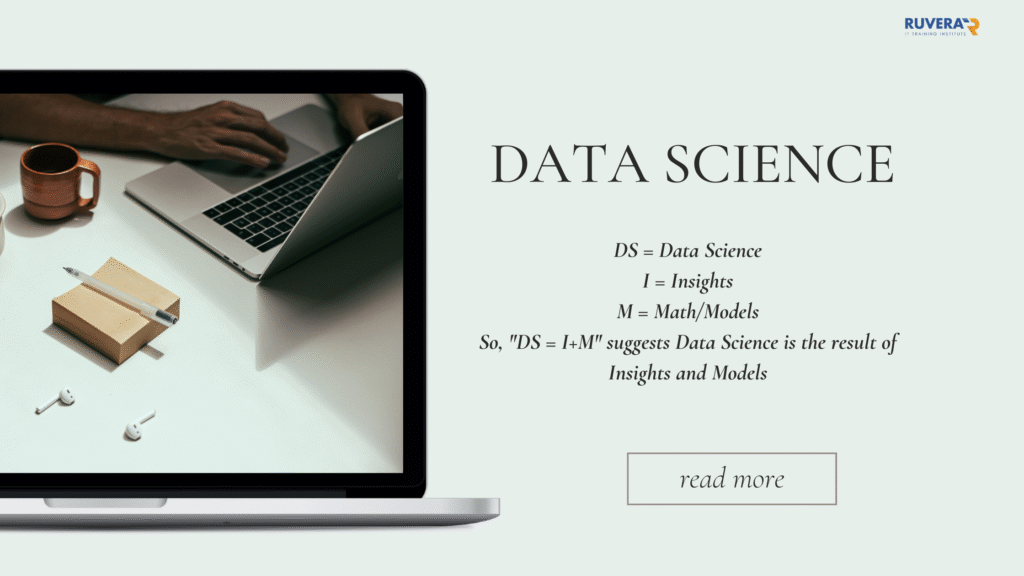
What Is Data Science? A Complete Guide for Students & Career Seekers in 2025
By Ruvera IT Training Institute | Updated: September 2025

Data is everywhere—your favorite eCommerce apps, health trackers, banking platforms, or even your music playlists. But what happens to all that data?
This is where Data Science comes into play.
What Is Data Science?
Data Science is the practice of collecting, organizing, and analyzing data to find useful insights that can support business strategies, product innovations, and smarter decisions – making. It b rings together several field including:
- Mathematics
Statistics
Programming (Python, R, SQL)
Machine Learning
Domain Expertise
- Think of it as a way to turn raw information into something meaningful — like predicting what customers will buy, detecting fraud, or recommending content.
Why Is Data Science So Important?
As the world becomes more digital, the amount of data generated is exploding. Every swipe, click, or transaction creates information that, when analyzed correctly, reveals patterns, behaviors, and opportunities.
Companies across industries — from retail and healthcare to finance and government — rely on data scientists to make sense of this information.
According to recent research, the global data science market is expected to reach $378.7 billion by 2030, growing at a CAGR of over 16%. That’s a huge signal for anyone considering a future-proof career.
Who Is a Data Scientist?
A Data Scientist is a professional who uses tools and algorithms to analyze large volumes of data and extract actionable insights. They are problem-solvers who work across teams to:
Identify trends and patterns
Create machine learning models
Visualize data for business decisions
Solve real-world problems using data
They often work with product teams, marketing, finance, operations, or tech departments to optimize processes and improve outcomes.
Key Skills Required to Become a Data Scientist
Want to become a data scientist? Here’s what you’ll need:
| Skill Area | Tools / Concepts |
|---|---|
| Statistics | Hypothesis testing, probability, regression |
| Programming | Python, R, SQL |
| Data Handling | Pandas, NumPy, Excel |
| Machine Learning | Scikit-learn, TensorFlow, PyTorch |
| Visualization | Tableau, Power BI, Matplotlib, Seaborn |
| Databases | MySQL, MongoDB, Hadoop |
You don’t need to master all of them at once. Start with Python and basic statistics, and build up from there.
Applications of Data Science in Real Life
Data Science powers many of the services we use daily. Here are some practical examples:
E-commerce: Product recommendation systems (like Amazon or Flipkart)
Healthcare: Predicting diseases, analyzing medical scans, drug development
Finance: Fraud detection in credit cards, stock price predictions
Self-driving cars: Cars make real-time decisions using data inputs from sensors
Voice Assistants: Siri, Alexa, and Google Assistant use natural language processing
Entertainment: Netflix or YouTube suggesting what to watch next
Common Types of Data Science Analysis
Data scientists use different types of analysis depending on the business problem:
Descriptive Analysis: What happened? (e.g., past sales trends)
Diagnostic Analysis: Why did it happen? (e.g., drop in user engagement)
Predictive Analysis: What is likely to happen? (e.g., forecast future demand)
Prescriptive Analysis: What should we do about it? (e.g., optimize pricing strategies)
The Data Science Process (Simplified)
Here’s a step-by-step breakdown of how data science typically works:
Collect Data: From sources like websites, databases, APIs, etc.
Clean Data: Fix errors, remove duplicates, and format it properly
Explore Data: Use visualizations to find patterns
Model Data: Apply machine learning algorithms to make predictions
Evaluate & Interpret: Check the model’s accuracy and share insights with teams
Tools Data Scientists Use
Some popular tools include:
Analysis & Modeling: Python, R, Excel, RapidMiner
Data Warehousing: Hadoop, Talend, BigQuery
Visualization: Tableau, Power BI, Jupyter
Cloud Platforms: AWS, Azure, Google Cloud
Automation: H2O.ai, DataRobot, AutoML tools
Industries That Use Data Science
Data Science is not just limited to tech companies. Here are some industries where it plays a huge role:
Retail: Understanding customer preferences and increasing sales
Banking: Risk analysis, credit scoring, and fraud detection
Manufacturing: Predictive maintenance and supply chain optimization
Healthcare: Disease diagnosis, drug discovery
Travel: Price optimization, route planning
Marketing: Campaign targeting and performance tracking
How to Become a Data Scientist (Step-by-Step)
✅ Step 1: Learn the Fundamentals
Start with Python, statistics, and Excel. Free YouTube videos or beginner courses can help.
✅ Step 2: Master Core Concepts
Take a structured course that covers data handling, ML algorithms, and real-world projects.
✅ Step 3: Work on Projects
Try analyzing public datasets (like COVID-19 data or IPL stats). Build a portfolio on GitHub.
✅ Step 4: Learn from Others
Join communities, participate in Kaggle competitions, and follow top data science blogs.
✅ Step 5: Apply for Internships or Entry-Level Jobs
Real-world experience matters. Start small and grow from there.
Career Opportunities After Learning Data Science
Here are some common job roles you can aim for:
| Role | Description |
|---|---|
| Data Analyst | Analyzes datasets to answer business questions |
| Data Scientist | Builds models and forecasts trends |
| Machine Learning Engineer | Focuses on building & deploying ML models |
| Business Intelligence Analyst | Builds dashboards & visual insights for teams |
| AI Specialist | Develops artificial intelligence applications |
| Data Engineer | Manages data pipelines and infrastructure |
Salary Insights for Data Science in India (2025)
Here’s what you can expect to earn:
| Experience Level | Average Salary (INR per year) |
|---|---|
| Fresher / 0-2 Years | ₹6 – ₹10 LPA |
| Mid-Level (3-5 Years) | ₹12 – ₹20 LPA |
| Senior (5-10 Years) | ₹20 – ₹35+ LPA |
| Data Science Manager | ₹35 – ₹60+ LPA |
Cities like Bangalore, Mumbai, Hyderabad, and Pune offer some of the best opportunities and packages
Is Data Science Right for You?
If you enjoy solving problems, love working with numbers, and are curious about how things work, then yes — data science could be perfect for you.
Whether you’re a recent graduate or a working professional looking to upskill, learning data science opens doors to global career opportunities.
Ready to Start Your Data Science Journey?
At Ruvera IT Training Institute, we offer an industry-focused, mentor-led Data Science & Business Analytics program to help students:
 Learn from real-world case studies Build job-ready skills in ML, Python, SQL, Power BI Work on capstone projects Get career support and placement assistance
 100% Job Assistance | 8-Month Program | Certification from Top Institute
Final Thoughts
Data Science is more than just a buzzword — it’s one of the most exciting, high-growth career paths of this decade. With demand rising across industries and tools becoming more accessible, there’s never been a better time to start.
Let data open doors for you. Start learning today.
RUVERA
IT TRAINING INSTITUTE
JOIN US TO GET SUCCESS IN YOUR LIFE BY GETTING YOUR DREAM JOB